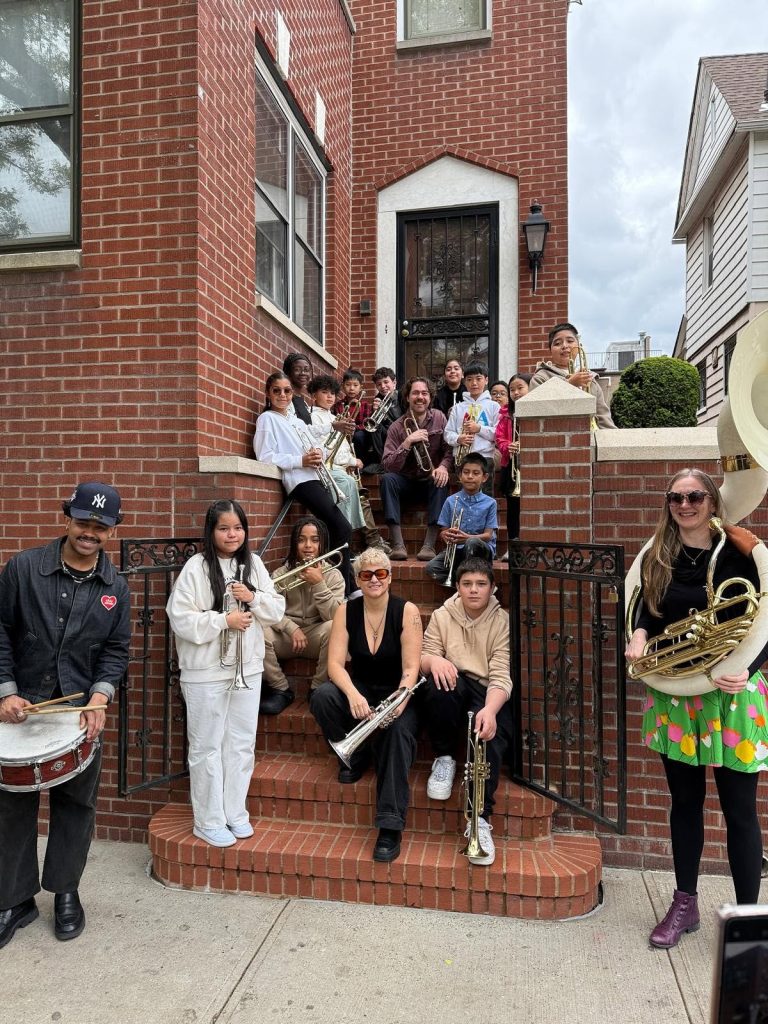
At the Louis Armstrong House Museum & Louis Armstrong Center, students can explore the life, music and legacy of one of the most influential jazz musicians in history through Louis Armstrong’s preserved home, personal recordings, archival material and a multimedia exhibition. K–12 programming includes Welcome to Pops’ House, which combines a guided house tour with an interactive presentation led by a professional jazz musician. Discussions connect jazz with emotional expression, technology, segregation and the Civil Rights Movement. Younger students can experience live jazz through Pops is Tops!, designed for grades K–6, while the Trumpet Learning Program introduces ages 8–16 to performance, technique and the New Orleans jazz tradition.
What Students Will Experience
A field trip here is unusually personal because students are not simply visiting a museum about Louis Armstrong—they are entering the actual Queens home where Armstrong and his wife, Lucille, lived for nearly three decades. The preserved house contains furnishings and personal objects that help students see Armstrong as both a person and a world-renowned performer.
During Welcome to Pops’ House, students begin with an introduction to Armstrong, then tour the home and hear rare personal recordings of Louis and Lucille that are available only at the museum. A professional jazz musician then leads an interactive presentation, giving students the chance to connect what they have seen in the house with the sound, improvisation and traditions of jazz itself.
Across the street, the Louis Armstrong Center adds a contemporary multimedia dimension through the Here to Stay exhibition. Students can encounter digitized music scores, book drafts, personal letters, collage art and recordings drawn from the museum’s extensive collections. These materials make it possible to examine Armstrong as a musician, writer, artist, technology enthusiast and public figure rather than reducing his story to a greatest-hits biography.
Live music is another major strength. Pops is Tops!, the museum’s longest-running children’s concert series, brings world-class jazz musicians to students in grades K–6 in the museum’s garden. For young learners who may never have attended a live jazz performance, the experience introduces improvisation, rhythm, instrumental technique and the communal nature of the music in an accessible format.
Students interested in playing music can go further through the Trumpet Learning Program, serving ages 8–16. Beginner through performance-level classes introduce posture, fingering, embouchure, scales, ensemble playing and repertoire. Seasonal camps and discovery programs can add opportunities to rehearse with professional artists and perform with a live band.
Curriculum & Grade-Level Connections
The museum welcomes learners from kindergarten through higher education, and school visits can be tailored around specific learning objectives. Programs meet New York State and New York City learning standards, giving teachers flexibility to connect the site with music, U.S. history, civil rights, technology, language arts and cultural studies.
For elementary students, Armstrong’s story provides an accessible introduction to jazz, self-expression, perseverance and community. Pops is Tops! is designed especially for grades K–6, while the house tour can be adapted for students of different ages.
Middle and high school teachers can move into more complex topics. Armstrong’s career offers a window into segregation, racism, touring in Jim Crow America and the Civil Rights Movement. Museum programming specifically addresses his struggle with segregation and his role in the fight for civil rights, allowing teachers to connect music history with broader social and political change.
Technology is another valuable angle. Armstrong was fascinated by recording equipment and extensively documented his own life through audio. Students can consider how changes in recording technology helped spread jazz and celebrity culture across the 20th century.
The museum also offers after-school programming for grades K–12 across all five boroughs. These interdisciplinary residencies draw on Armstrong’s digitized archives and can include music-making, composition, rhythm, creative expression and study of the origins of jazz.
Planning Your Visit
Group visits are currently scheduled Thursday through Saturday, and the museum recommends reserving at least two weeks in advance because time slots fill quickly. Group sizes range from a minimum of 10 to a maximum of 50 visitors.
All group visits begin at the Louis Armstrong Center at 34-56 107th Street in Corona, across the street from the historic home. This is an important logistical detail for bus drivers and trip leaders, since the Center—not the house—is the starting point.
Accessibility differs between the two buildings. The Armstrong Center, including the exhibition, welcome area, shop and restrooms, is fully wheelchair accessible. The historic house is not wheelchair accessible and requires visitors to climb two sets of steep stairs and stand for approximately 45 minutes. Students unable to enter the house can request a video tour. ASL interpretation and verbal-description tours are available with at least three weeks’ advance notice, and personal care attendants are admitted free.
There is no café, and food is not allowed indoors. Bagged lunches may be eaten in the museum garden when weather permits, and tables and chairs can be requested.
For teachers, the strongest visits are those that frame Armstrong not only as a famous musician but also as a primary-source-rich entry point into jazz, Black history, civil rights, technology and 20th-century American culture.