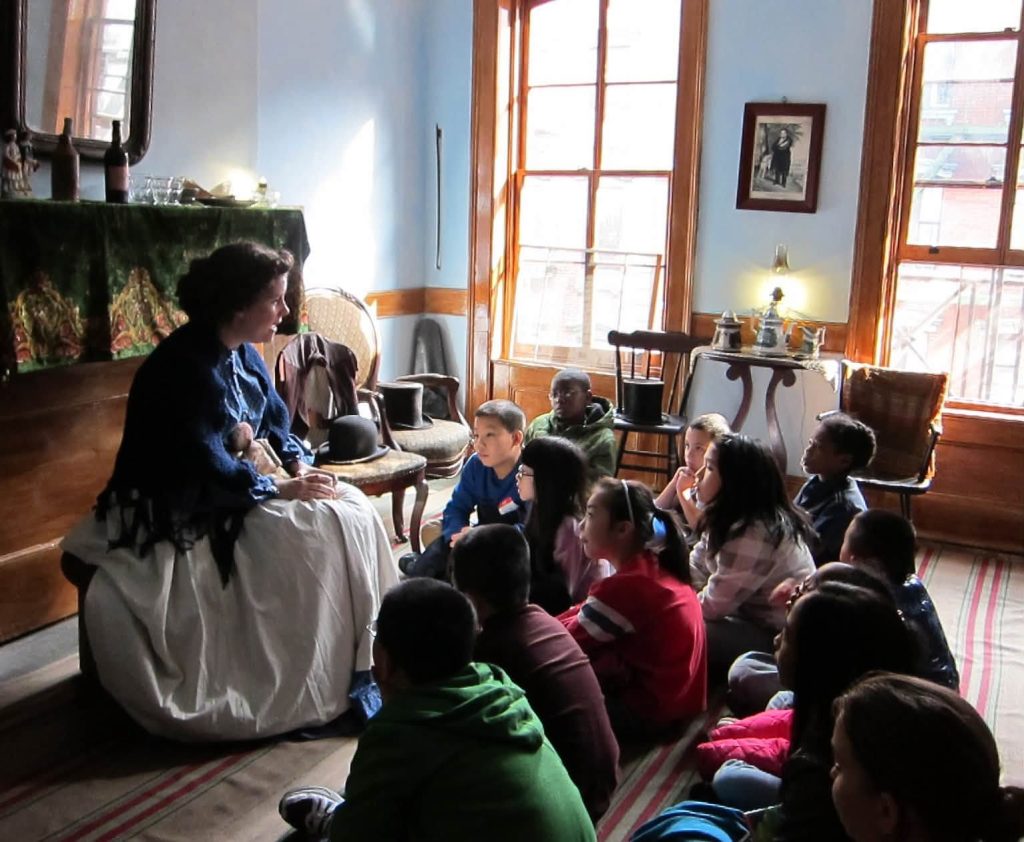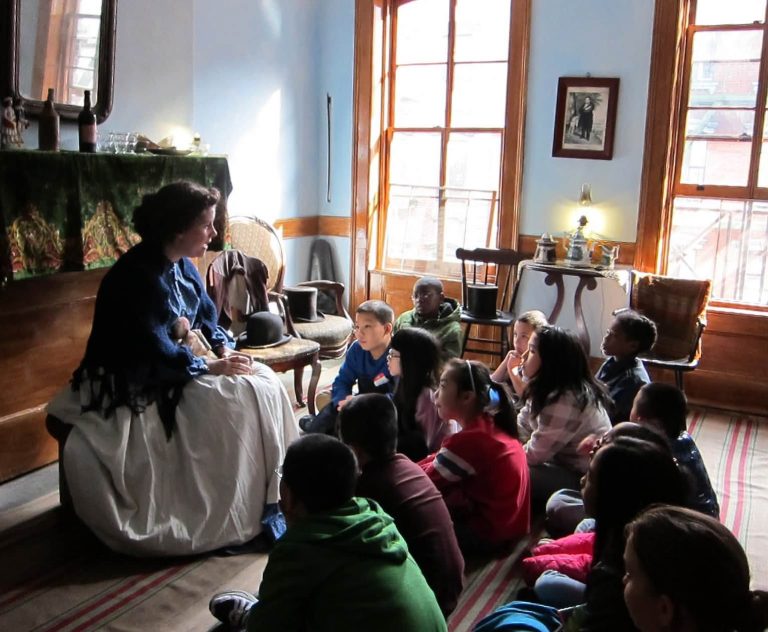
Immigration and migration history come to life inside historically recreated Lower East Side apartments and on the surrounding neighborhood streets at the Tenement Museum. Specialized one-hour programs for grades K–12 use storytelling, objects, activities and educator-led conversation to connect the experiences of past residents with students’ own lives. Rather than presenting immigration as a single story, the museum explores themes of cultural identity, discrimination, family, work, community and human rights through the lives of people who lived in its tenement buildings across the 19th and 20th centuries. Virtual programs are also available, using prerecorded video, 360-degree imagery and primary sources to bring the Lower East Side into classrooms anywhere.
What Students Will Experience
The Tenement Museum’s school tours are immersive because students enter historically recreated apartments associated with real families. Rooms, furniture, household objects and stories help students understand immigration at the scale of individual lives rather than through statistics alone.
Current apartment tours include experiences such as 100 Years Apart, After the Famine: 1869, Family Owned, A Union of Hope: 1869, Tenement Women: 1902, Under One Roof and Finding Home. Each tour focuses on different families, time periods or social themes, allowing educators to match a program with classroom topics.
Students might examine how immigrants earned a living, adapted cultural traditions, raised families or responded to discrimination. The museum’s educators use storytelling, activities, and questions rather than simply lecturing, encouraging students to connect residents’ experiences to migration in their own families or communities.
Costumed interpreter programs offer another form of immersion. In Meet Victoria, students interact with an interpreter portraying an actual tenement resident and can ask questions about her home, journey to the United States and life on the Lower East Side. A Spanish-language version is also available.
Schools can choose a neighborhood walking tour as well. Outside the Home takes students through the Lower East Side to examine how streets, businesses, religious institutions and community spaces shaped immigrant life. Walking tours take place outdoors rain or shine and do not enter the tenement buildings.
Virtual programs recreate many of these experiences remotely. Museum educators use 360-degree images, prerecorded footage and primary sources to guide students through apartments or neighborhood spaces from the classroom.
Curriculum & Grade-Level Connections
The Museum serves all K–12 grade levels, and its school programming aligns with National Education Standards, the C3 Framework and multi-state Social Studies Scope and Sequence.
For elementary students, educators can emphasize family, neighborhoods, migration, traditions and the differences between homes in the past and present. Students can examine how children lived, worked and participated in family life in crowded tenement apartments.
Middle school groups can explore industrialization, urbanization, immigration policy, labor, discrimination and changing communities. Because tours feature real families rather than generalized categories, students can consider how historical forces affected specific people.
High school groups can investigate more complex themes including race, class, gender, labor rights, housing, assimilation, cultural identity and human rights. Tours such as Tenement Women and Under One Roof provide strong entry points into social history and changing migration patterns.
The museum’s inquiry-driven approach also supports language arts. Students practice listening, discussion, evidence-based interpretation and perspective-taking while comparing personal narratives with larger historical trends.
Because school programs explicitly connect the past to students’ own experiences, teachers can use the museum to discuss the continuing relevance of immigration and migration without assuming every student shares the same family history or cultural background.
Planning Your Visit
Onsite school programs last approximately one hour and are generally offered Monday through Friday at 10 a.m., 11 a.m. and 4 p.m. Other times, weekends and holidays may be available at premium rates. Reservations must be requested at least two weeks in advance, although earlier booking is recommended because daytime slots fill quickly.
At least one adult chaperone is required for every 14 students, and chaperones count toward the total participant count.
Schools traveling by bus from outside Manhattan are encouraged to choose an 11 a.m. slot to allow more time for traffic and bus logistics.
Accessibility varies because the museum occupies historic tenement buildings. Finding Home is currently identified as a wheelchair-accessible apartment tour, and teachers should describe mobility, sensory or other needs in detail when submitting the reservation request so staff can recommend the best option.
Walking tours proceed rain or shine, so groups choosing a neighborhood program should arrive with appropriate clothing and footwear.
The museum is especially valuable for educators who want students to understand immigration as a human story shaped by work, housing, discrimination, family and belonging rather than as a single chapter in a textbook.