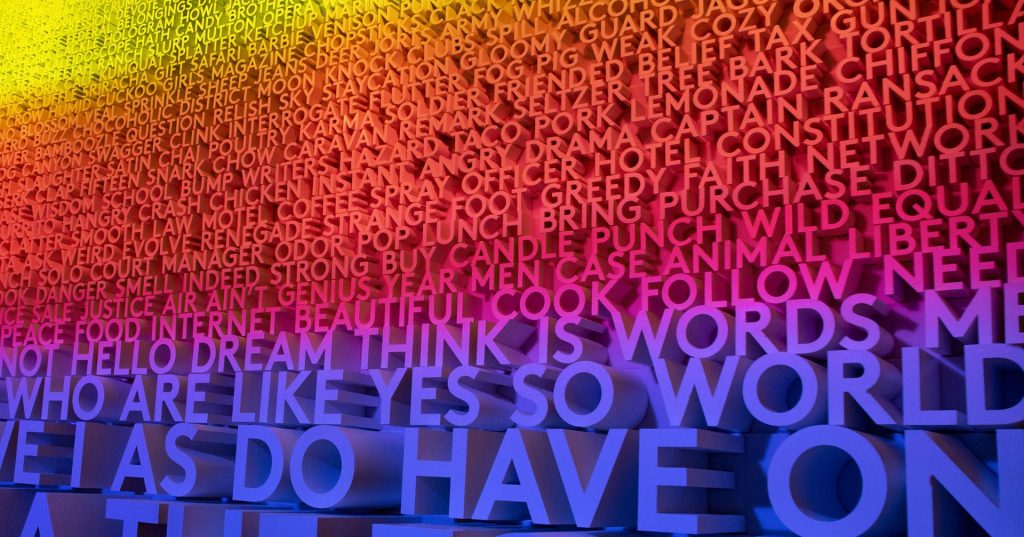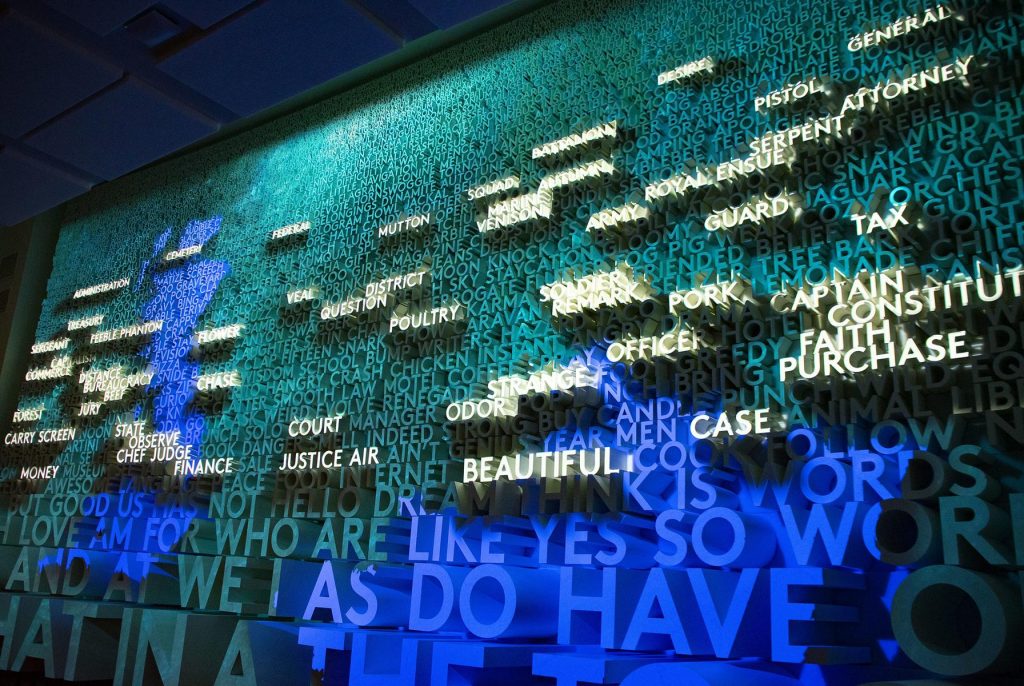
Let your students sing, speak, read, write and play their way through language learning at Planet Word Museum. Self-guided school visits encourage groups to explore interactive galleries where words, books, voices and language become something to experiment with rather than study. Educator-led Wordshops for grades 3–12 provide sharply focused curriculum options: younger students can play with idioms and storytelling, middle-grade learners can explore language and poetry, and older students can investigate advertising, public communication, media and news literacy. Wordshop packages combine an educator-facilitated lesson with focused gallery time, allowing students to apply ideas immediately through interactive exhibits.
What Students Will Experience
Planet Word is built around participation. Students are encouraged to speak aloud, listen closely, read, sing, record, perform and play with language throughout the museum. Rather than asking groups to move quietly past display cases, the galleries use technology and interactive media to demonstrate how words shape communication, culture and identity.
A self-guided school visit lasts approximately 90 minutes, giving students time to explore exhibits at their own pace. They may encounter books that appear to come alive, experiment with spoken language, discover how languages develop and change or explore the power of persuasive and expressive words. Planet Word explicitly describes its philosophy as “learning by doing,” and its galleries are designed around active participation rather than passive observation.
For a more structured experience, schools can book a Wordshop Experience Package. These combine an educator-led Wordshop with an additional hour of focused self-guided gallery exploration. Because students first learn a concept in a facilitated setting and then encounter related ideas in the galleries, the structure works particularly well for teachers who want a clear curricular purpose behind the field trip.
Curriculum & Grade-Level Connections
Planet Word’s Wordshops are designed for grades 3–12 and are aligned with Common Core skills. Individual topics are deliberately grade-banded.
For grades 3–5, Go Bananas for Idioms explores literal and figurative language through games, drawing and humor. Students analyze expressions that can’t be understood word-for-word and create their own visual interpretations.
Words Matter, for grades 4–7, uses personal narrative to examine how people tell stories about themselves and how those stories connect to broader social themes. Students analyze storytelling techniques before creating their own narrative.
Other Wordshops extend into middle and high school, with topics involving poetry, language identity, advertising, persuasive communication, fact-checking and media literacy. This makes Planet Word useful not only for English language arts classes but also for journalism, communications, civics and social studies.
Teachers can also use Planet Word’s free lesson plans before or after the visit. Resources are organized for elementary, middle and high school learners and include standards-aligned activities, teaching supports and customizable Google Slides. This makes the trip easier to integrate into an existing unit rather than treat as an isolated enrichment activity.
Planning Your Visit
Planet Word has unusually specific group-visit procedures, so teachers should plan early. Any group of 20 or more people must arrange a group reservation in advance; ordinary timed-entry passes cannot be combined to substitute for a group booking. The museum currently requires group requests to be submitted at least five weeks in advance, and high-demand dates can fill well before the requested visit.
Self-guided school visits last about 90 minutes. Wordshop packages typically run for roughly two hours: an educator-led workshop followed by an hour of gallery exploration. Wordshops generally accommodate classes of 35 or fewer, making them best suited to individual classes or larger groups that can be divided into rotations.
Planet Word offers limited free visits for qualifying local Title I schools, while other school groups pay group admission and, when applicable, a workshop fee. Because those free allocations are limited, schools hoping to use them should reserve as early as possible.
Teachers should also prepare students for a museum that is intentionally vocal and interactive. Quiet gallery behavior isn’t the goal here; the exhibits build in speaking, singing, and participation. Groups benefit from clear chaperone expectations so students can engage enthusiastically without losing track of their assigned teams.
Virtual Wordshops offer another useful option for schools outside Washington or for classes that want a focused introduction before an eventual visit. The same educator-led topics can be delivered remotely, allowing teachers to use Planet Word either as a destination or as part of a broader language-arts unit.