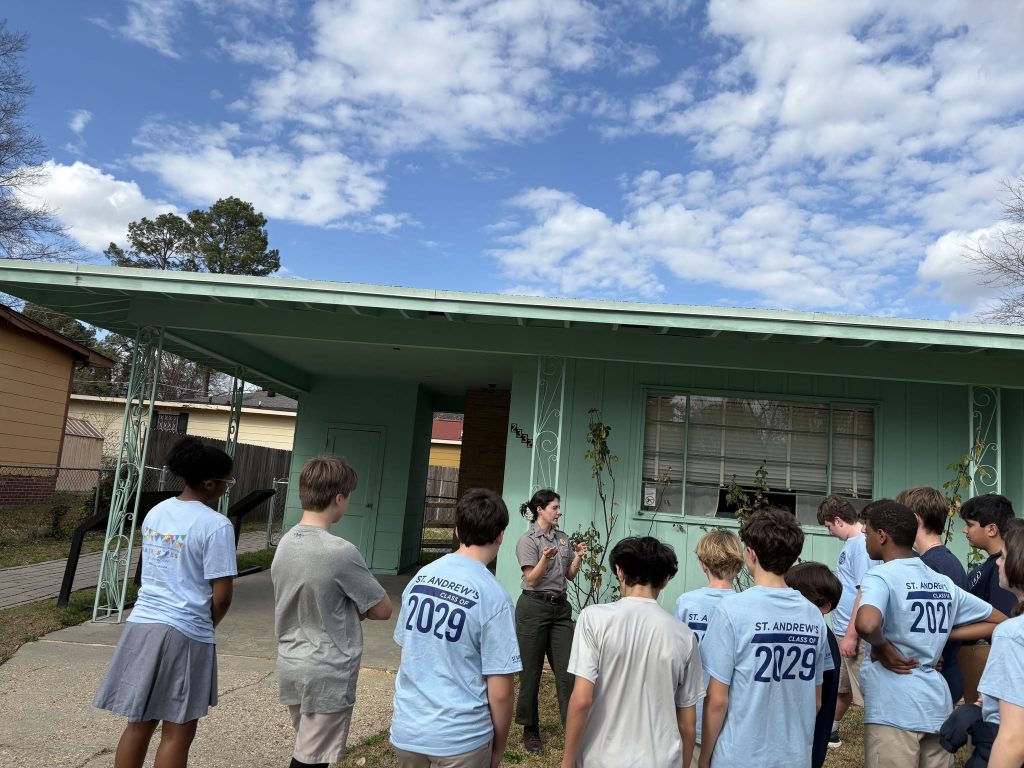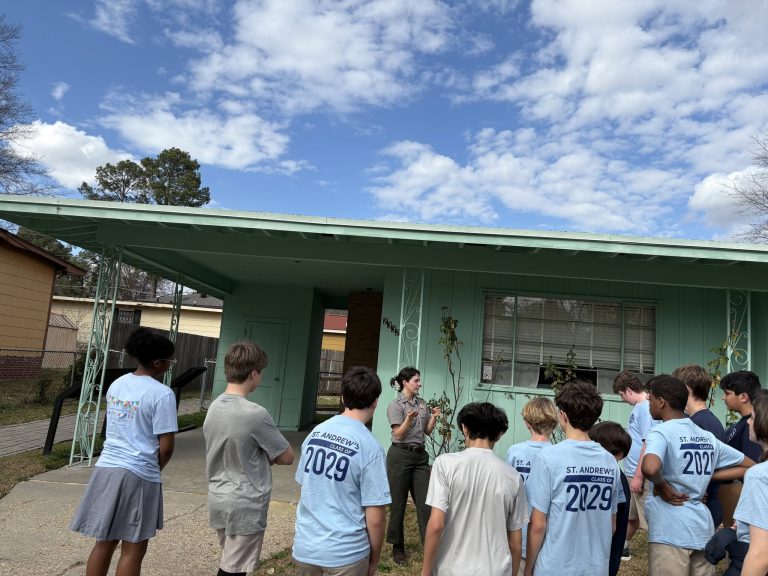

History feels a little different when you can connect it to a real home, a real family, and a real neighborhood. The Medgar and Myrlie Evers Home National Monument in Jackson, Mississippi, gives students that opportunity while introducing them to two important figures in the Civil Rights Movement. Medgar Evers was the first Mississippi field secretary for the NAACP and spent years working to increase voter registration, fight segregation, and bring attention to racial violence throughout the state. His wife, Myrlie Evers, was also deeply involved in civil rights work and became a nationally recognized leader herself. The Evers family home became an important part of their story, particularly after Medgar was assassinated outside the house on June 12, 1963. Today, the home and surrounding neighborhood help preserve that history and give students a more personal way to understand the people behind the Civil Rights Movement.
Learning Opportunities
Because the Medgar and Myrlie Evers Home National Monument is a newer addition to the National Park System, the National Park Service is still developing plans and visitor accommodations for the site. Teachers should check the park’s website before planning an in-person field trip for the latest information. Even so, the location offers plenty of opportunities for meaningful learning. Students can explore the history of the Evers family, learn about Jackson’s role in the Civil Rights Movement, and use the site as a starting point for discovering other civil rights landmarks throughout the city. A teacher could also have students create a timeline of Medgar Evers’ life or research the different ways he and Myrlie worked to create change. For younger students, simply discussing what it might have been like to grow up in a family at the center of such an important movement can make history feel much more relatable.
Immersive History
Teachers can bring several interesting details into the classroom before a visit. Medgar Evers was born in Decatur, Mississippi, in 1925 and served in the U.S. Army during World War II before attending Alcorn A&M University, now Alcorn State University. In college, he participated in sports, debate, journalism, and student leadership. After graduating, he became increasingly involved in civil rights activism and eventually moved to Jackson to work for the NAACP. He traveled throughout Mississippi encouraging African Americans to register to vote and investigated cases of discrimination and racial violence. Myrlie Evers was also an activist and leader, eventually serving as chairperson of the NAACP and helping establish the Medgar and Myrlie Evers Institute in Jackson.
The site works especially well for lessons on American history, civil rights, government, journalism, and social studies. Students can explore how newspapers, speeches, and public demonstrations helped bring attention to the Civil Rights Movement, making Medgar Evers’ work especially interesting for classes studying communication and journalism. The surrounding Medgar Evers Historic District also adds another layer to the experience. The neighborhood was the first modern subdivision designed for middle-class African Americans in Mississippi after World War II, giving teachers a way to discuss community, homeownership, and life for Black families during the era of segregation.
The Medgar and Myrlie Evers Home National Monument is a powerful reminder that important history does not always happen in a classroom or a museum. Sometimes, it happens at home. By learning about the Evers family and their work in Mississippi, students can see the Civil Rights Movement through a more personal lens and better understand the courage it took to challenge injustice. Whether explored in person through visitor opportunities or alongside the National Park Service’s online resources, the site gives students a chance to connect Mississippi history to a much larger American story.