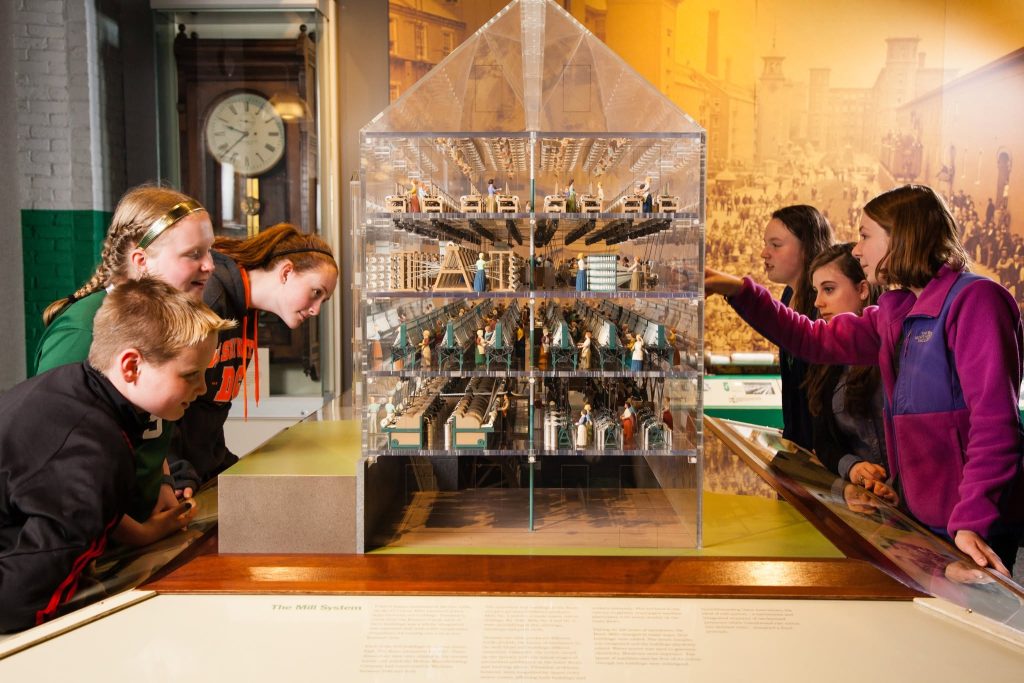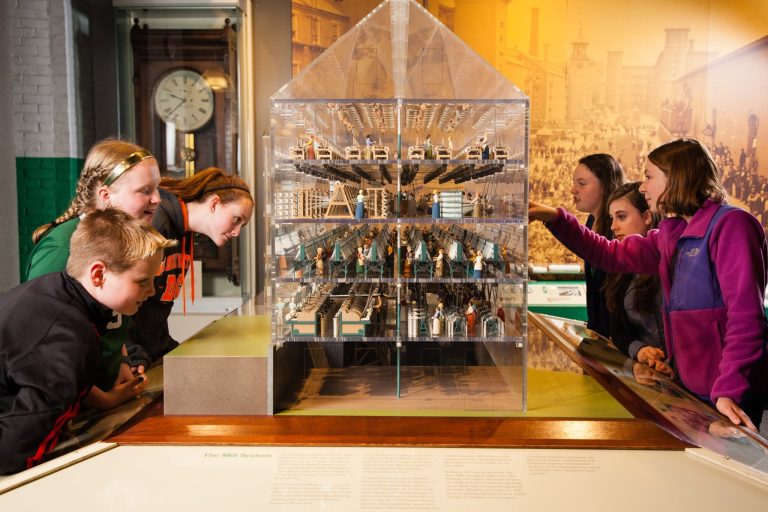
At Lowell National Historical Park, the Tsongas Industrial History Center immerses students in America’s Industrial Revolution through full-day, curriculum-connected programs built around authentic historic sites. Students can weave on handlooms, work on an assembly line, test water wheels, engineer machines, design functioning canal systems and conduct water-quality research on the Merrimack River.
Visits may include a restored mill-girl boardinghouse, an operating turbine and the dramatic Boott Cotton Mills weave room, where 88 power looms demonstrate the noise and scale of industrial production. Programs serve grades 2–12 and combine social studies, science, engineering and environmental learning in ways that make Lowell itself part of the lesson.
What Students Will Experience
Tsongas is one of the region’s strongest examples of place-based learning because students investigate industrial history in the actual spaces where it unfolded. Rather than simply hearing about textile production, they can enter the Boott Cotton Mills, examine machinery and experience the scale and sound of a working weave room.
In Power to Production, for grades 4–12, students work as engineers. They test water wheels for speed and strength, record and graph data, build a functioning canal-and-mill system and investigate how cams, belts, pulleys and gears transferred energy from water to textile machinery. The program then connects those experiments to the historic Suffolk Mill turbine and Lowell’s industrial waterpower system.
Engineer It!, for grades 3–12, challenges teams to design and build devices using the engineering-design process. Students examine historic power looms and turbines to see how earlier engineers solved manufacturing problems, then apply similar thinking to their own design challenge.
History programs are equally active. In Workers on the Line, grades 4–12 work on an assembly line under changing workplace conditions, then use artifacts and historic spaces to examine how workers organized and fought for better treatment.
In Yankees and Immigrants, grades 4–12 unpack the belongings of immigrants and refugees, investigate individual stories, visit an 1840s boardinghouse and participate in a town meeting based on tensions between native-born residents and Irish immigrants.
Curriculum & Grade-Level Connections
Tsongas programs are explicitly organized by grade and subject. Community Connections serves grade 2; Change in the Making grades 3–4; Engineer It! grades 3–12; and Bale to Bolt, Power to Production, Workers on the Line and Yankees and Immigrants primarily serve grades 4–12. River as a Classroom targets grades 5–8, while other offerings extend into high school.
The programming is unusually interdisciplinary. Power to Production and Engineer It! support engineering, energy and systems thinking; Workers on the Line connects labor history with economics and civics; Yankees and Immigrants supports immigration, identity and community studies; and River as a Classroom integrates ecology, Earth science and human environmental impact.
During River as a Classroom, grades 5–8 travel by boat on the Merrimack River or Lowell canals, collect water samples, perform water-quality tests and analyze data. They also build and test water filters and use models to examine global water distribution.
Teachers can extend these experiences with extensive pre- and post-visit materials. Available classroom activities address immigration, industrialization, environmental impacts, water power, historical images, and even literature such as Lyddie.
Planning Your Visit
Most field trips are structured as a full school day, generally running about 9:15 a.m.–1:25 p.m. or 9:45 a.m.–1:55 p.m. depending on the program and date. Staff can sometimes adjust the schedule around transportation constraints, but teachers should discuss timing during reservation.
Most programs accommodate up to 30 students, while Engineer It! is capped at 27 and Community Connections at 25. Schools can often book multiple concurrent sessions for larger groups. Each group must include at least two adults, with a minimum ratio of roughly one adult per 10 students and a maximum of six adults per group.
All programs involve some outdoor walking regardless of weather, so students need appropriate clothing and footwear. For River as a Classroom, schools must keep their buses in Lowell because transportation is needed during the program. The river program is seasonal, currently offered in early fall and again from May to mid-June.