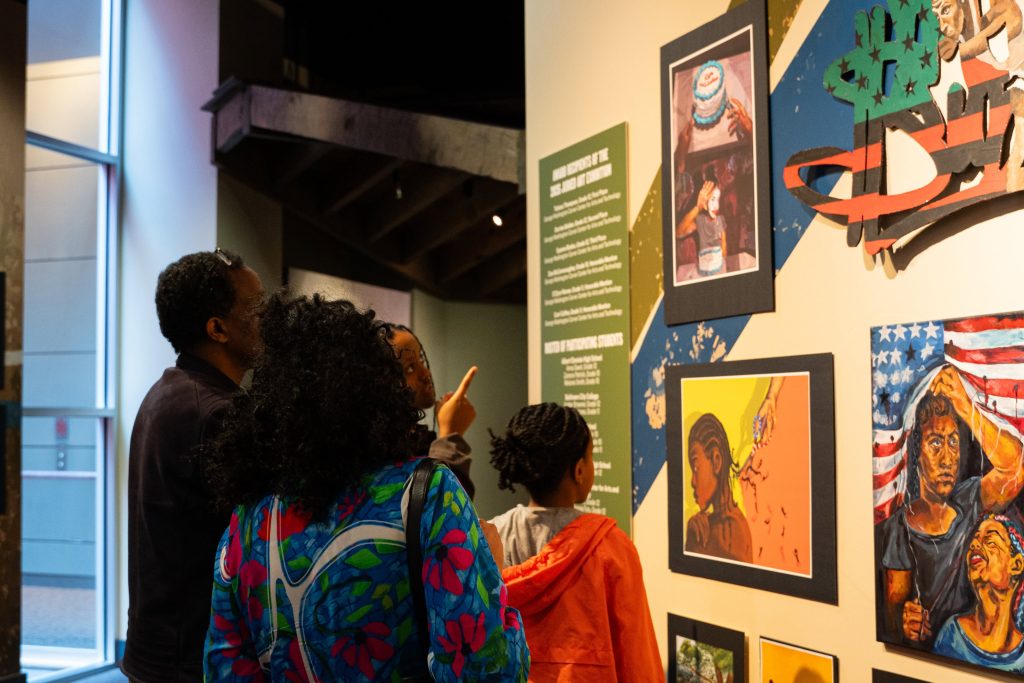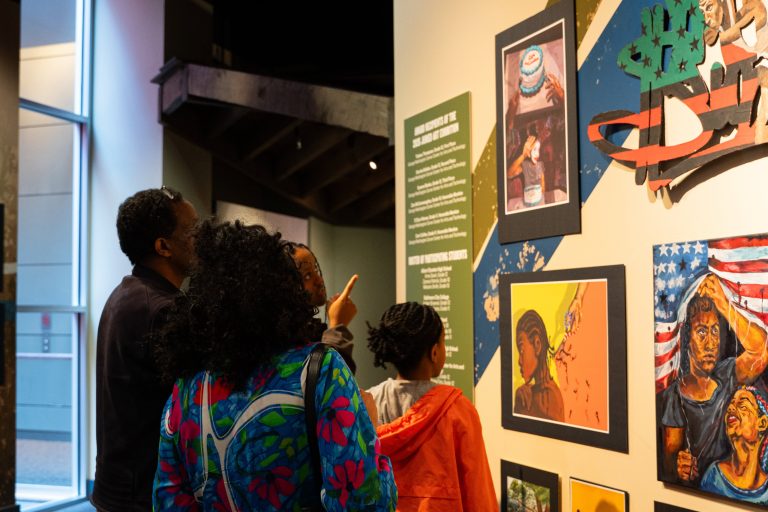
Discover more than 300 years of African American Maryland history at the Reginald F. Lewis Museum, where stories of creativity, community, achievement and resistance come into focus.
Grades 3–12 can explore important people, places and traditions on the Heritage tour, while Paths to Freedom allows grades 4–12 to examine slavery through the experiences of free and enslaved Black Marylanders. The Fight for Justice, also for grades 4–12, investigates Jim Crow, the Civil Rights Movement and campaigns for equality. Guided tours encourage discussion and historical interpretation, while self-guided groups use gallery activity sheets to strengthen observation and critical-thinking skills. The museum’s broader education programs help students connect Maryland stories with national struggles for liberty, equality and self-determination.
What Students Will Experience
The Lewis places African American Marylanders at the center of the historical narrative. Students encounter stories spanning enslavement, emancipation, community building, work, culture, education, civil rights, art and contemporary life.
The Heritage tour, designed for grades 3–12, introduces students to more than three centuries of people, traditions and places that shaped African American Maryland. For groups studying slavery and emancipation, Paths to Freedom for grades 4–12 examines the experiences of both enslaved and free Black Marylanders from the colonial era through the Civil War. The Fight for Justice, also for grades 4–12, shifts to Jim Crow and the Civil Rights Movement, highlighting Marylanders who challenged discriminatory laws and institutions.
These topics naturally invite difficult questions about freedom, equality and power. Rather than avoiding those complexities, museum educators use exhibits and discussion to help students consider how individuals and communities responded to injustice and how Maryland history connects to larger national struggles.
Self-guided visits also support active learning. Groups receive a museum overview and can use gallery activity sheets designed to encourage close looking, observation and critical thinking. The museum can accommodate up to 100 students on a self-guided school visit, making that option particularly useful for larger grade levels.
Students can also connect history with creativity through optional studio art activities tied to current exhibitions. These hands-on experiences invite learners to respond artistically to the themes, people and artworks they encounter in the galleries. Exhibition tours may also include scavenger hunts, and Title I schools and schools participating in free-lunch programs may qualify for free exhibition tours and studio experiences.
The museum’s current exhibitions add further opportunities for secondary students. The Lines We Cross: 250 Years of Maryland Forging America, on view through October 31, 2027, explores how Black Marylanders navigated physical, political and cultural boundaries while shaping the state and nation. Themes include abolition, liberation, creativity and the struggle to claim freedom and full citizenship.
Curriculum & Grade-Level Connections
The Lewis serves K–12 school groups, although its three primary themed guided tours begin at grade 3 or 4. Museum tours align with Maryland State Curriculum Standards and complement An African American Journey, an educational resource developed by the Maryland State Department of Education.
For elementary learners, the museum can support lessons about family, community, culture, important Marylanders and the meaning of freedom. The Heritage tour begins at grade 3 and provides a broad introduction for students who may be encountering African American Maryland history in depth for the first time.
Middle school classes can move more deeply into slavery, resistance, the Civil War, Reconstruction, segregation and civil rights. Paths to Freedom is especially useful for helping students distinguish between the experiences of enslaved and free Black Marylanders and understand that African American history in the state included both oppression and active resistance.
High school students can address more complex themes involving citizenship, systemic racism, activism, political participation, labor and historical memory. The Fight for Justice provides a particularly strong foundation for examining Jim Crow and Maryland’s role in the broader Civil Rights Movement.
The museum’s teacher resources extend those themes into the classroom. Available lessons address subjects ranging from the Middle Passage and enslaved labor to Harriet Tubman, the U.S. Colored Troops, the Harlem Renaissance, jazz and the Baltimore Uprising.
Virtual school experiences provide another option. Virtual tours last approximately 45–60 minutes and can serve up to 50 K–12 students, with activity sheets available to support the experience. The museum also offers virtual exhibits on runaway freedom seekers, Maryland protest movements and African American photography.
Planning Your Visit
Guided school tours are available for groups of 10–60 students and last approximately 90 minutes. Current guided-tour times are Monday, Thursday and Friday at 10 a.m., 11:30 a.m. and 1 p.m. Larger groups should contact the museum directly about accommodations.
Self-guided school visits can accommodate up to 100 students and include a museum overview and gallery activity sheets. Schools should plan field trips at least three weeks in advance, as reservations fill quickly. The museum asks groups to arrive approximately 15 minutes before their scheduled tour time.
Financial assistance is available through the museum’s Children’s Access Program and State-Aided Institutions Program, which can provide free admission and bus transportation for qualifying Title I schools. Limited assistance may also be available to other schools participating in free or reduced-price meal programs.
Lunch planning requires advance thought. The museum no longer operates a café and has limited space for brown-bag lunches, so educators should discuss meal plans when booking rather than assuming lunch space will be available.
The museum is ADA-accessible, and visitors using mobility aids can navigate the building. A limited number of wheelchairs are available on a first-come, first-served basis, and sign-language interpretation can be arranged through Visitor Services.
Located at 830 E. Pratt Street near Baltimore’s Inner Harbor, The Lewis is also easy to incorporate into a broader Baltimore history or civics itinerary. Schools bringing motorcoaches should request current group drop-off and parking instructions before arrival.