Students can step into the role of historians and historical investigators as they examine authentic artifacts, artworks, documents and primary sources at the Maryland Center for History and Culture. Age-differentiated school programs help educators build curriculum-focused field trips that connect Maryland history to broader American stories.
For grades K–2, Life Then & Now uses art, object handling and sensory learning to compare jobs, homes, schools and communities of the past with students’ lives today. Colonial Maryland, designed for grades 3–8, invites learners to examine objects and primary sources from the 1600s and 1700s while investigating the people and forces that shaped Maryland’s economy and culture. The new WayFinders: Making Sense of Our World school program offers grades K–5 a hands-on, sensory journey through Maryland history, where students can investigate how figures such as Benjamin Banneker and Mary Katharine Goddard used observation, tools and knowledge to navigate their world.
What Students Will Experience
The Maryland Center for History and Culture gives students access to the kinds of evidence historians actually use. Rather than simply reading about Maryland history, learners examine original objects, artwork, photographs, documents and other materials and consider what those sources reveal about people and communities.
In Life Then & Now, for grades K–2, students compare everyday life across time. Art, object handling and sensory-friendly activities help younger learners examine how work, housing, schooling and communities have changed. The program is designed for groups of approximately 10–60 students and lasts about 90 minutes.
For grades 3–8, Colonial Maryland moves students into more analytical historical inquiry. Students travel through Maryland’s history in the 1600s and 1700s while investigating the people, economic forces and cultural influences that shaped the colony. Original objects and primary sources become evidence students can question and interpret rather than simply view behind glass.
One of the Center’s newest learning experiences is WayFinders: Making Sense of Our World, which opened in March 2026. Designed primarily for children ages 5–11, the permanent exhibition encourages visitors to use sight, sound, touch and smell while exploring how people navigated both the natural world and challenging historical circumstances. Students can turn clock gears, follow sound signals, operate a bucket elevator to uncover a mastodon fossil, compare scents in a beehive and use tools such as a compass and magnifier.
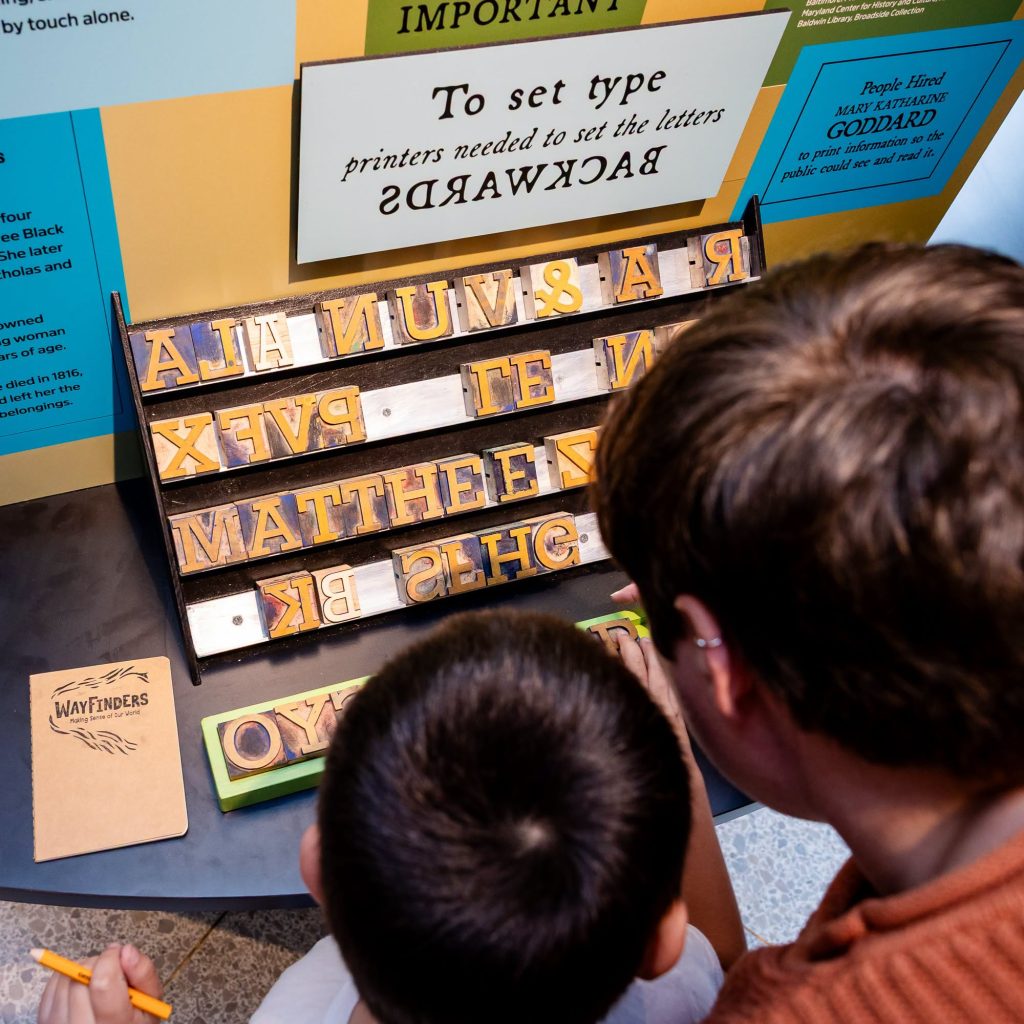
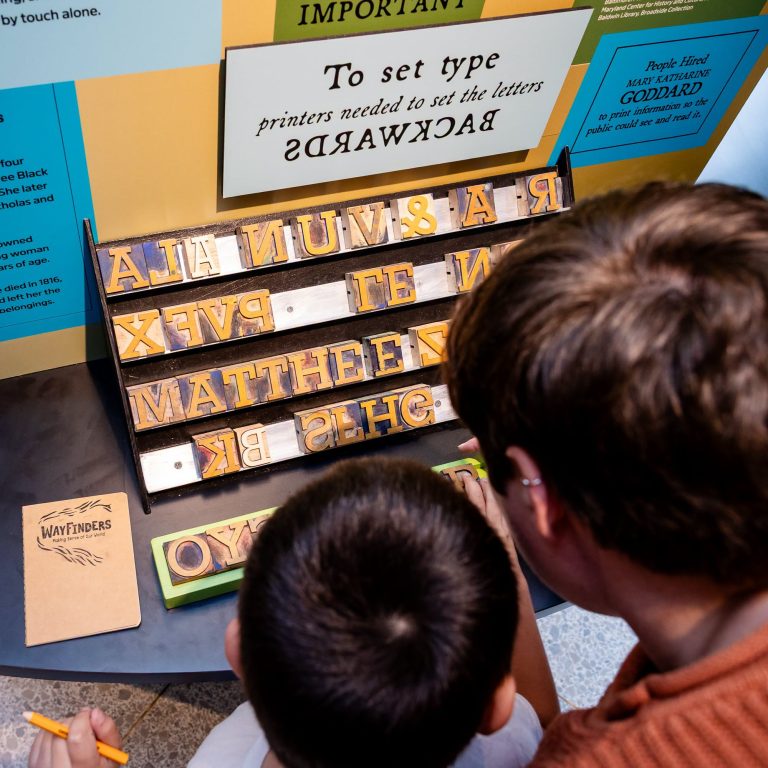
The accompanying WayFinders school tour, designed for grades K–5, introduces five figures or groups from Maryland history through hands-on activities. Students might learn to survey land like Benjamin Banneker or create broadsides inspired by printer Mary Katharine Goddard. Because of the exhibition’s size, school-tour capacity is currently limited to 30 students.
The exhibition also introduces students to Charles Willson Peale, Mendes Cohen and Indigenous people of the Chesapeake, giving teachers opportunities to connect history with science, navigation, printing, art and observation.
Curriculum & Grade-Level Connections
MCHC’s education programs span Maryland history from the period before European settlement through the modern Civil Rights era, with onsite, virtual and classroom-based resources available across grade levels.
For grades K–2, Life Then & Now focuses on change over time and provides a developmentally appropriate way to study community history. Students can compare familiar parts of their lives—school, work, home and neighborhoods—with the experiences of Marylanders in earlier generations.
Grades 3–8 can go deeper through Colonial Maryland, examining the people and economic systems that shaped the state during the 17th and 18th centuries. Because the program relies on artifacts and primary sources, it also helps students develop historical-thinking skills such as observation, inference, sourcing and evidence-based interpretation.
WayFinders adds an especially strong interdisciplinary option for grades K–5. Its focus on navigation, sensory evidence and problem-solving makes it possible to blend history with STEM and the arts. Students can consider how Banneker used mathematics and observation, how Goddard communicated information through printing and how Indigenous people of the Chesapeake interpreted the natural landscape.
The Center’s educational mission extends beyond onsite field trips. Current resources include virtual field trips, primary-source sets and traveling trunks, allowing teachers to continue inquiry before or after a visit. MCHC’s collections include millions of books, documents, manuscripts and photographs as well as hundreds of thousands of museum objects, giving the institution a deep foundation for primary-source learning.
For educators, this makes MCHC particularly valuable for teaching students not just historical content but also how historians know what they know. Original evidence becomes the starting point for questioning, comparison and interpretation.
Planning Your Visit
Programs such as Life Then & Now and Colonial Maryland last approximately 90 minutes and can accommodate groups of about 10–60 students. The guided WayFinders school program is also approximately 90 minutes but is limited to 30 students because of exhibition-space constraints.
WayFinders itself is best suited to ages 5–11, and educators should allow approximately 60–90 minutes for independent exploration of the exhibition.
The museum is located at 610 Park Avenue in Baltimore’s Mount Vernon neighborhood and is currently open Wednesday through Sunday, 10 a.m. – 5 p.m.
Parking is available at the nearby Franklin Street Parking Garage, with same-day validation available through Visitor Services. Metered and free street parking can also be found nearby, and ADA-accessible parking is available on Park Avenue, Centre Street and surrounding streets.
The museum is wheelchair accessible, and its newer WayFinder Wing was designed with improved accessibility and visitor experience in mind. Current school-program listings also identify Life Then & Now, Colonial Maryland and the WayFinders tour as suitable for students requiring sensory-friendly, wheelchair-accessible, special-education or ESL/ELL supports.
The museum has no food service, so schools should plan meals elsewhere or ask the education team about current group-lunch arrangements when reserving.
For elementary teachers in particular, WayFinders makes the Center much more than a traditional history museum. Students can handle, investigate, build, navigate and observe while learning how Marylanders used knowledge and evidence to make sense of their world—the same skills young historians use today.