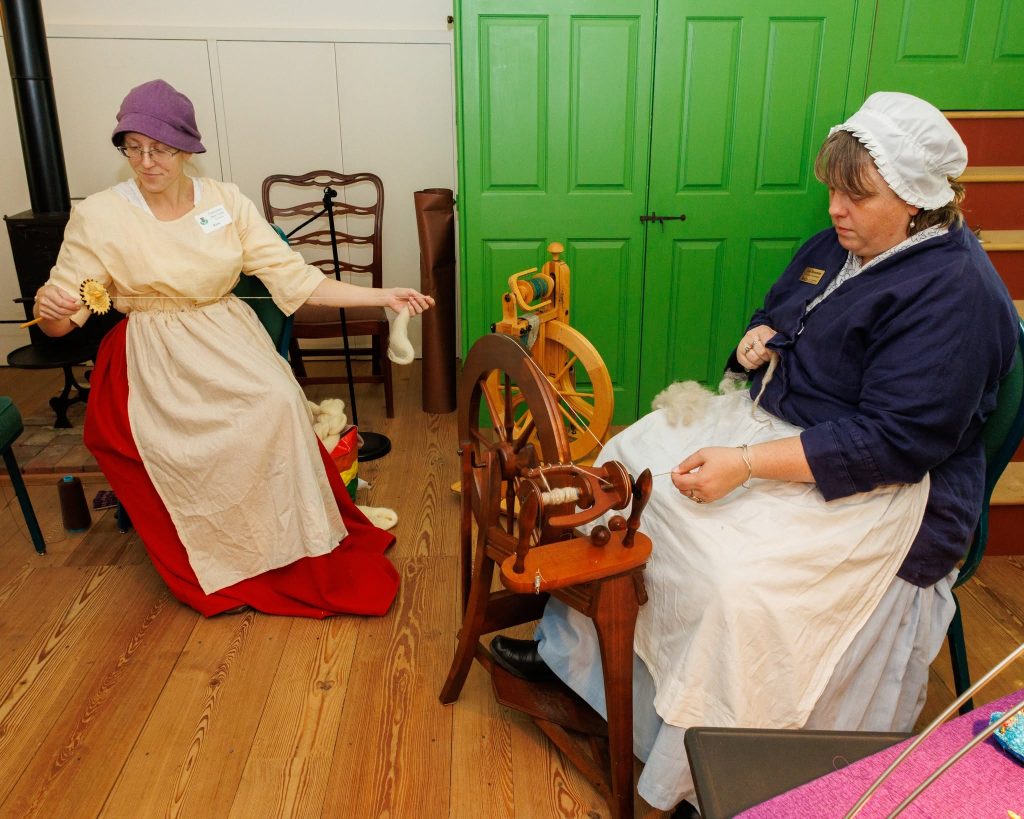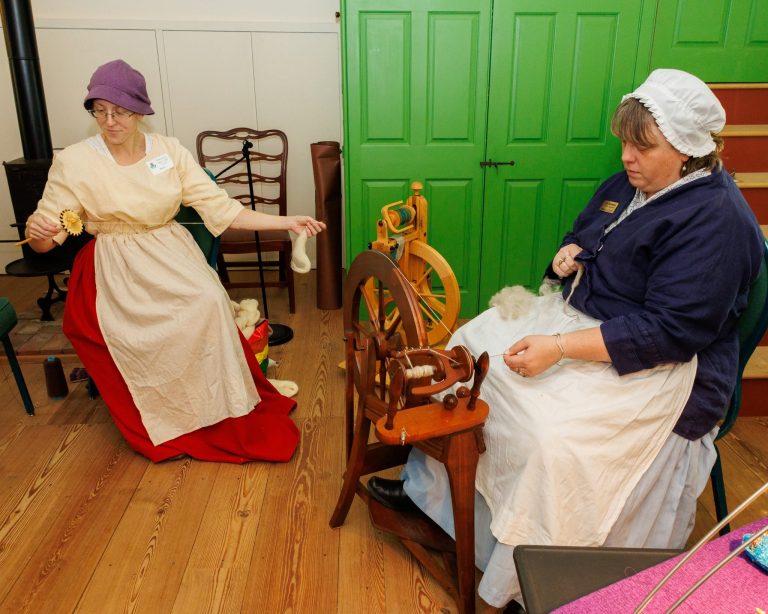
Educational tours at the John Dickinson Plantation take students into a layered historical landscape where they examine the experiences of the Dickinson family, tenants, free Black residents, enslaved men, women and children, and tradespeople. The Then and Now program for grades K–3 compares colonial childhood and daily life with the present; Politics and Plantation for grades 3–12 explores Dickinson’s world through the mansion, outbuildings and primary sources; and A World Apart examines free and enslaved Black communities. Older students can investigate how historians use evidence to interpret the site, while optional demonstrations such as hearth cooking and weaving make colonial work visible and tangible.
What Students Will Experience
The John Dickinson Plantation provides a more complicated view of the founding era than a visit focused only on a famous statesman. John Dickinson was an influential political writer and public figure, but the site’s interpretation deliberately expands beyond him to include the people whose labor and lives sustained the plantation.
Students tour the historic mansion and surrounding landscape while examining the social relationships that shaped the property. Politics and Plantation, for grades 3–12, explores Dickinson’s life alongside the tenants, enslaved people, tradesmen and merchants with whom he interacted. The program uses the mansion, outbuildings and primary resources to help students consider how one plantation connected politics, economics and labor.
A World Apart, also for grades 3–12, focuses more closely on enslaved people and free Black residents in the Jones Neck area. Rather than presenting slavery only in national terms, the program gives students a local Delaware context and encourages them to consider differences in status, opportunity, work and freedom.
For younger learners, Then and Now compares life in the Dickinson household and surrounding community with children’s experiences today. Students in grades K–3 can consider differences in homes, possessions, work, family responsibilities and childhood routines in a way that makes the colonial past easier to grasp.
Teachers may also arrange a thematic demonstration, such as weaving or hearth cooking, to give students a concrete look at the skills and labor required in daily life.
Curriculum & Grade-Level Connections
School tours are designed to complement Delaware Social Studies Standards, with different options for specific developmental levels.
The K–3 Then and Now program works particularly well for early elementary lessons involving past versus present, community, family life and change over time. Students can practice comparison skills while making personal connections to historical objects and routines.
For grades 3–12, Politics and Plantation offers stronger links to colonial history, the founding era, economics and civics. Because students encounter John Dickinson alongside enslaved laborers, tenants, and tradespeople, the program also supports discussion of power, social hierarchy, and whose experiences the historical record represents.
Dickinson Plantation Profiles, designed for grades 5–12, goes even further by examining how historians use primary and secondary sources to interpret the site. That makes the plantation especially useful for teachers emphasizing historical thinking, evidence, bias and source analysis rather than memorization.
For middle and high school students, the site can also support broader discussions about the contradictions of the American founding. Dickinson advocated constitutional rights and political liberty while living within a society dependent on slavery. Framing the visit around those tensions can help students understand that the founding era included competing ideas about freedom, citizenship and human rights.
Planning Your Visit
Most school programs last 1½ to 2 hours, while Dickinson Plantation Profiles runs about 2 hours. Large groups must reserve in advance, and teachers can request an additional thematic demonstration when scheduling.
Admission to the site is currently free, and the plantation provides ample free parking with space for buses. The visitor center and first floor of the mansion are accessible to visitors with disabilities. Because access to upper floors and certain historic spaces may be limited, teachers should discuss mobility needs before arrival.
Current public hours vary somewhat by day. Outdoor visitation is available Tuesday, while the visitor center and grounds are open Wednesday through Saturday. Guided mansion tours are generally offered Thursday through Saturday at scheduled times. School groups, however, should coordinate directly with the site rather than relying on the general public schedule.
The plantation sits southeast of Dover Air Force Base, making it easy for planners to pair the site with another Dover-area attraction, such as the Air Mobility Command Museum. The two destinations offer sharply different perspectives—one grounded in colonial politics and labor, the other in modern military technology—making them a useful combination for groups building a full-day Delaware itinerary.