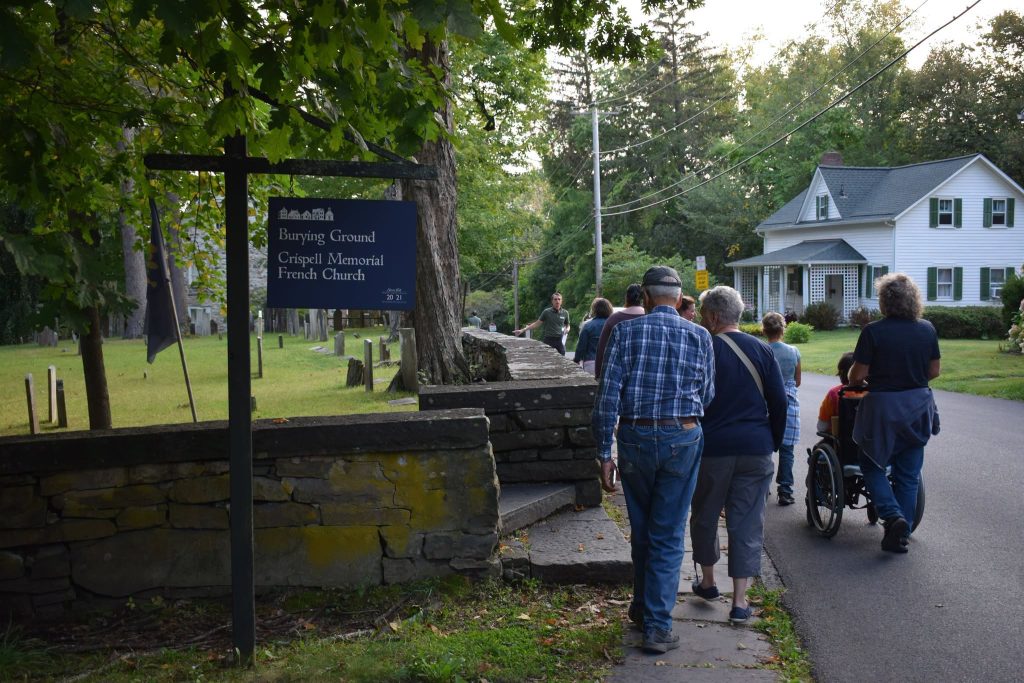
At Historic Huguenot Street, students step into more than three centuries of Hudson Valley history across a 10-acre National Historic Landmark District. Seven historic stone-house museums, a reconstructed 1717 French church, burial ground and replica Esopus Munsee wigwam allow groups to investigate Indigenous history, European settlement, slavery, family life and community change in one place. Standards-based school programs serve pre-K through grade 12, with experiences tailored by developmental level. Younger learners compare colonial childhood with their own lives, grades 3–6 investigate objects and primary documents, and grades 7–12 examine Indigenous, Huguenot and enslaved perspectives through historic buildings, archives, gravestones and hands-on activities such as quill writing.
What Students Will Experience
Historic Huguenot Street’s educational strength lies in the fact that students encounter multiple histories within one small landscape. Rather than treating the site solely as a story of French Huguenot settlers, current programming incorporates the experiences of the Esopus Munsee, enslaved Africans and other residents whose lives shaped New Paltz.
For kindergarten through grade 2, Colonial Kids uses hands-on activities to help children compare their own lives with childhood in the colonial era. Students can play reproductions of colonial games or examine household objects using observation and their senses to determine how people used unfamiliar tools. Activities generally run 20–30 minutes each.
For grades 3–6, Learning & Leisure in the 18th Century adds greater historical analysis. Students can work with archival documents such as the 1677 land agreement involving Huguenot settlers and the Esopus Munsee or examine runaway notices issued by local enslavers. Guided questions help students interpret primary sources and consider Indigenous-settler relations and slavery within the local community.
Students in grades 7–12 can participate in One Street, Many Stories, a two-hour program combining several immersive experiences. Inside the replica Esopus Munsee wigwam, students discuss construction, daily life and Indigenous culture. In the Abraham Hasbrouck House, they explore both the colonial family who lived there and the enslaved people who served them. At the burial ground, students use gravestones as historical evidence to make observations and inferences about people from the past. The program concludes with quill writing, allowing students to create a journal entry from either their own perspective or that of an 18th-century resident.
Other secondary-level programs, including Qui Voyez-Vous? and In Her Shoes, provide additional options for grades 7–12.
Curriculum & Grade-Level Connections
Historic Huguenot Street’s K–12 programs are recognized by the New York State Cultural Education Department for alignment with New York standards and Common Core standards.
The developmental progression is particularly useful for repeat visits. A Little History serves pre-K and kindergarten; Colonial Kids serves K–2; Learning & Leisure serves grades 3–6; and several more analytical programs are available for grades 7–12.
Elementary students can focus on past and present, household life, games, tools and community. Upper elementary groups begin using primary sources and examining more difficult subjects such as slavery and Indigenous-European relationships.
Middle and high school learners can address colonization, land agreements, cultural conflict, enslavement, religion and historical memory. One Street, Many Stories explicitly aligns with New York Social Studies and English standards, including writing, comprehension and collaborative discussion.
The site also supports language arts through journal writing, archival reading, and perspective-taking. Archaeology, architecture and material culture provide additional connections to art, design and historical inquiry.
For schools unable to travel, Historic Huguenot Street offers outreach programs within a 60-mile radius of New Paltz, bringing several school-program themes directly into classrooms.
Planning Your Visit
Program lengths vary by grade. A Little History runs about 1½ hours; Colonial Kids and Learning & Leisure run about two hours; One Street, Many Stories and Qui Voyez-Vous? about two hours, and In Her Shoes about three hours.
Teachers should select activities before the visit. In programs such as Colonial Kids and Learning & Leisure, activity choices are made in advance and generally cannot be changed on the day of the trip.
The site offers important financial assistance. Title I schools receive discounted admission, and the Community Foundations of the Hudson Valley offers field-trip grants to public schools in Dutchess and Ulster counties.
Because Historic Huguenot Street spans an outdoor historic district, students should wear comfortable shoes and dress for the weather. Some programs move among stone houses, the burial ground and the wigwam, so educators should discuss mobility or other access needs with staff in advance.
For teachers looking for a field trip that complicates the traditional “colonial settlement” narrative, Historic Huguenot Street is particularly valuable. Students encounter French Huguenot settlers, Indigenous inhabitants and enslaved residents within the same physical landscape, allowing them to see how very different lives and perspectives intersected in the making of one Hudson Valley community.