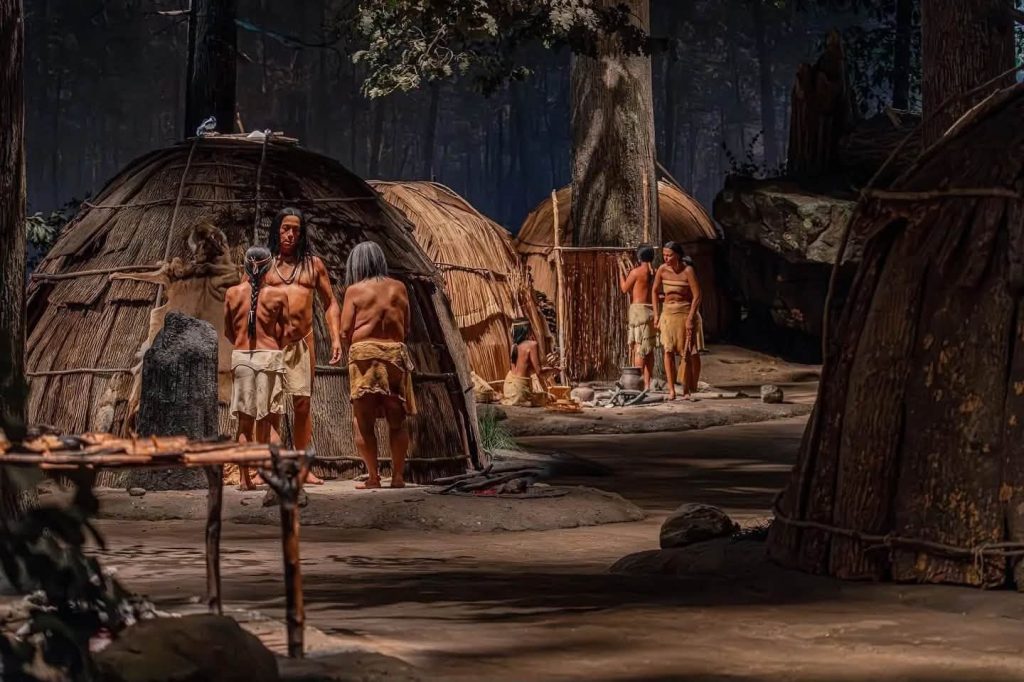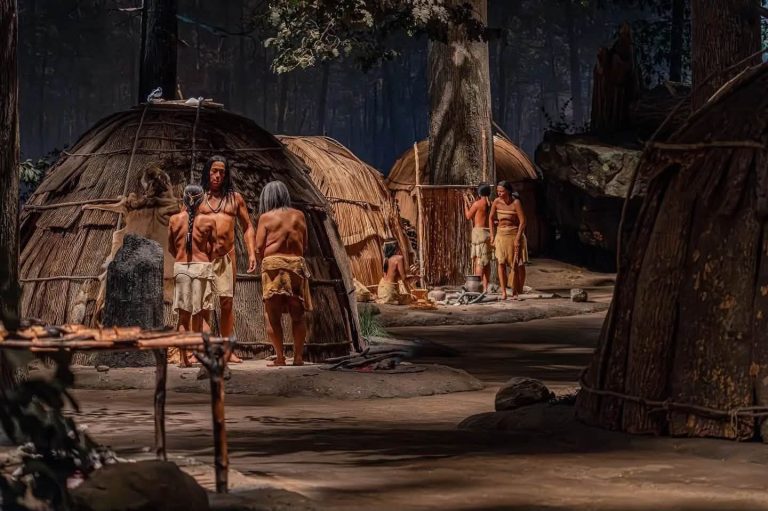
Explore 20,000 years of Native history in a remarkable immersive environment at the Mashantucket Pequot Museum & Research Center. Students connect with the past through Indigenous perspectives, multimedia exhibits and sensory experiences in a recreated Pequot village.
Traditional wetu homes and scenes depicting cooking, work, storytelling and community life help students envision the Eastern Woodlands across time. Educator-led programs deepen inquiry and cultural understanding, while a hands-on archaeology experience lets students interpret evidence from three different periods of Pequot history. Groups can also add programming about powwow traditions or a workshop exploring the origin and cultural significance of wampum.
What Students Will Experience
The Mashantucket Pequot Museum offers something especially valuable for school groups: students encounter Native history from an Indigenous institution that connects ancestral experience with thriving Native communities today. The museum’s multimedia environment uses reconstructed spaces, objects, sound and storytelling to move beyond the idea of Native history as something confined to the distant past.
An Exhibit Highlight Tour, appropriate for all ages, guides students through key points across roughly 20,000 years of history. The hour-long Pequot Village Tour focuses more closely on daily life, work and play, with particular attention to what children’s experiences would have been like. A recreated village environment helps students visualize community life in ways a textbook cannot.
For grades 3 and up, Archaeology’s Window to the Past places students into small investigative teams. Using simulated refuse heaps representing three periods of Pequot history, learners identify artifacts, interpret evidence and consider how and why cultures change. Groups can also explore the history, dance, art and etiquette of modern powwows or add a hands-on wampum workshop in which students learn about shell materials and cultural meaning before creating a replica bracelet.
Curriculum & Grade-Level Connections
Museum education programs support reading, writing, speaking, listening, civic engagement and cultural literacy and are aligned with the College, Career and Civic Life (C3) Framework. That interdisciplinary approach makes the museum useful for far more than a unit on colonial New England. Teachers can connect to history, language arts, archaeology, civics, art, cultural studies, and Indigenous knowledge systems.
The guided Exhibit Highlight and Pequot Village tours suit all ages, allowing elementary groups to focus on family and daily life. At the same time, older students engage more deeply with colonization, cultural continuity, historical interpretation and Native sovereignty. The archaeology program’s grade 3+ recommendation reflects the greater analytical demands of sorting evidence and concluding artifacts.
A visit can also help educators challenge oversimplified classroom narratives. Because the museum explicitly connects ancestral histories with present-day Native communities, students can examine Indigenous culture as dynamic and contemporary rather than treating Native people solely as figures associated with precolonial or colonial America.
Planning Your Visit
School planners should pay close attention to group size. Discounted group admission is available for 10 or more participants with reservations, but guided tours and workshops are currently limited to groups of 30 or fewer participants per educator, excluding chaperones. Larger groups can still visit but may need to use self-guided exploration rather than certain educator-led experiences. Workshops carry separate fees, so schools should determine in advance whether they want general admission only or a more structured itinerary.
Chaperone requirements vary by age: approximately one adult for every five students in grades 1–3 and one for every 10 students in grades 4–12. Chaperones and teachers are expected to remain with students throughout the visit. Groups should arrive together, and payment for the group discount is handled as one transaction.
Teachers planning independent exploration may want to use the museum’s pre-visit highlight video before arrival. Lunches can be stored onsite and scheduled in the Pequot Café area. Accessibility features include closed captioning and infrared audio tours for visitors who are blind or have low vision. Most museum spaces are wheelchair accessible, although the stone flooring in portions of the replicated village can present challenges; educators with specific mobility or sensory needs should discuss accommodations when booking.