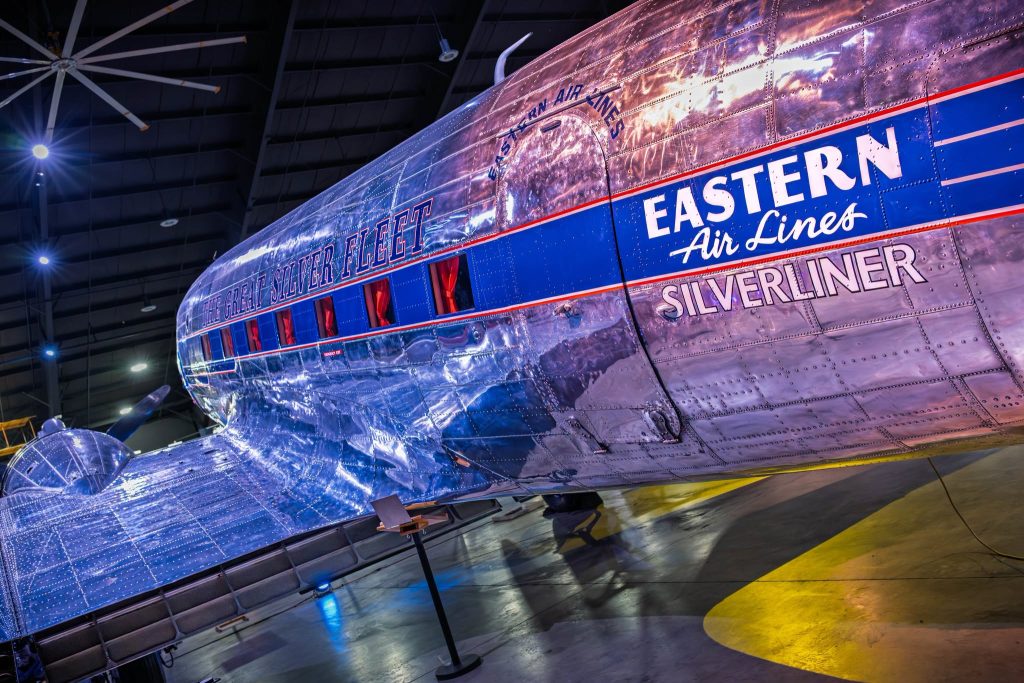
Aerospace, innovation and engineering are on full display at the New England Air Museum, where historic aircraft and authentic artifacts create a dramatic setting for STEM and history. Students in pre-K through grade 12 can join programs that bring aviation history and inquiry-driven learning together. Younger students experiment with flight and gravity by building flying machines and deploying parachutes, while grades 3–8 investigate lift, thrust, weight and drag by designing and test-flying straw gliders. Guided tours for grades 3–12 trace more than a century of aviation and New England innovation, from early flight to space exploration. Every school group also receives an age-appropriate scavenger hunt to encourage continued exploration.
What Students Will Experience
Few field trips make engineering feel as tangible as standing beside full-size aircraft while investigating the forces that allow them to fly. The New England Air Museum combines its extensive collection with guided tours, classroom programs and independent exploration, giving teachers flexibility to build a visit around history, STEM or both.
For pre-K and kindergarten, Things That Fly uses interactive storytelling and demonstrations to compare natural and mechanical flight before students construct and launch flying machines. Grades 1–2 can participate in Pushes, Pulls & Parachutes, experimenting with gravity and drag before designing a parachute that can carry a load. In Flight, Forces & Motion, grades 3–8 explore lift, thrust, weight, and drag through demonstrations, then apply those concepts by designing, building, and test-flying straw gliders. Each classroom experience lasts approximately 60 minutes and accommodates up to 30 students.
Groups also receive grade-appropriate scavenger hunts and time to explore independently, giving students a reason to look closely at aircraft, engines and artifacts throughout the museum rather than simply walking past them.
Curriculum & Grade-Level Connections
The museum’s programs are intentionally interdisciplinary, connecting aviation with science, technology, engineering and social studies. Guided tours expand those connections for older learners. Take Flight!, for grades 3–12, follows the development of lighter-than-air flight, airplanes and spaceflight while emphasizing New England’s contribution to aerospace history. Century of Innovation, also for grades 3–12, traces more than 100 years of Connecticut aerospace achievement, from early biplanes to space technology.
For grades 8–12, American Warbirds places military aircraft in historical context, examining aviation during World War II, the Cold War, Vietnam and later conflicts. This makes the museum particularly useful for secondary teachers who want to connect technology with major political and military events rather than treating engineering and history as separate subjects.
The museum also runs SOAR for STEM for grades 3–5 and offers programs introducing high school students to aviation careers. Homeschool groups have additional opportunities, including themed days featuring engineering professionals, aircraft access, demonstrations and hands-on activities.
Planning Your Visit
School field trips are offered from October 1 through the second week of June, and programs are designed around state and national curriculum frameworks. Teachers can choose a self-guided visit, guided tour, classroom program or a combination experience. Guided tours and most classroom sessions generally last an hour, so groups should allow additional time for scavenger hunts, independent exploration and lunch.
Current school-group options include discounted rates for self-guided admission, guided tours and classroom programming. School staff are admitted free, while parent chaperones receive a discounted admission rate. The museum requests one group payment at check-in; schools using purchase orders should arrange that when booking. Dining facilities are available for a lunch break, which is especially helpful for groups spending several hours onsite.
Reservations should be made well in advance. General group reservations require at least 10 participants, and the museum advises allowing up to two weeks for scheduling and confirmation. Teachers should also note individual program capacities: hands-on classroom programs generally accommodate up to 30 students, while some guided tours can serve groups of up to 45. Larger school groups may therefore need to rotate among activities.