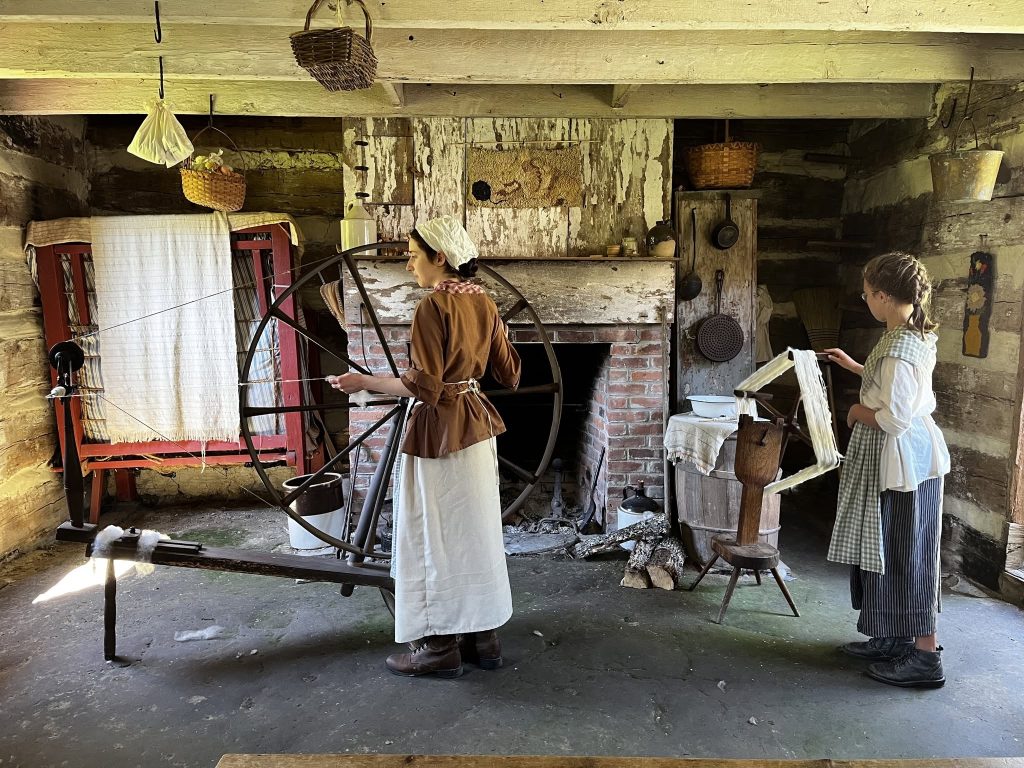
Students can roll up their sleeves and experience 19th-century Pennsylvania German farm life firsthand at Quiet Valley Living Historical Farm. Programs range from preschool experiences to secondary-level hands-on history and introduce foodways, animals, schooling, simple machines, crafts and agricultural work through active participation. Students might preserve food, create Pennsylvania German folk art, experiment with levers and inclined planes or spend a day in a reconstructed one-room schoolhouse. For grades 3 and up, the Farm Hand Adventure traces wheat and milk from raw ingredients to the table as students process grain, churn butter, knead bread dough and take home a freshly baked loaf. Seasonal programs connect each visit to the rhythms of a real farm.
What Students Will Experience
Quiet Valley’s educational programs are intentionally hands-on. Instead of watching interpreters demonstrate every historic skill, students often do the work themselves.
The Farm Hand Adventure, offered on weekdays in November and March for grades 3 and up, provides one of the most complete farm-life experiences. Students begin by learning how an early farmstead was established, then follow bread production from yeast and rising dough through baking. Each student kneads and shapes dough and takes home a small loaf. Groups also churn butter, process wheat and complete a craft, with an animal visit included when weather and time permit.
The One Room School Experience, also for grades 3 and up, recreates a school day in 1893. Students greet the schoolmarm, use slates, practice recitation and arithmetic, participate in geography and spelling lessons and enjoy old-fashioned recess games. The reproduction schoolhouse includes slant-top desks, slate blackboards and a potbelly stove, and students are even encouraged to wear period clothing if they wish.
Quiet Valley’s Hands-on History offerings let groups select shorter thematic programs. Students can investigate food preservation, trace changes in lighting technology, create Pennsylvania German folk art or explore the screw, lever and inclined plane through the Simple Machines program. That activity includes multiple hands-on challenges—including a catapult—and demonstrates how basic mechanical principles reduced labor on a historic farm.
Preschool learners are not left out. Seasonal programs for ages 2–6 introduce friendly animals, barns, historic buildings, farm chores such as gathering eggs or pumping water, storytelling and traditional games.
Curriculum & Grade-Level Connections
Quiet Valley offers education programs from preschool through high school, with each program having its own age recommendations.
For preschool students, the focus is sensory and experiential: animals, textures, chores, stories and movement. Programs help young children understand basic ideas about farms, food and life in the past without requiring advanced historical knowledge.
Elementary students can connect farm life with science topics such as animal needs, plant growth, food production and simple machines. Henrietta the Hen, for kindergarten and grade 1, uses a live chicken, storytelling and games to introduce farm life and science concepts.
Students age 9 and older can take on more sophisticated programs such as Simple Machines, which connects Pennsylvania German farm technology with screws, levers and inclined planes.
For grades 3 and up, the One Room School and Farm Hand experiences add strong social studies connections. Students can compare education, work, food and family responsibilities in the late 19th century with their own lives.
Programs are tied to Pennsylvania academic standards in areas including history, science and art. The Farm Hand Adventure, for example, incorporates history, science and arts standards while teaching about farm products such as wheat and milk.
The farm is also valuable for language arts. Students can write reflections from the perspective of a 19th-century child, compare historical and modern routines or investigate Pennsylvania German cultural traditions.
Planning Your Visit
Quiet Valley offers school programs year-round by reservation, even when the farm is closed to the general public. Individual programs are seasonal, so teachers should select dates based on the experience they want.
Trips run rain or shine, and the farm limits how many students it can accommodate each day. Every school program requires advance reservations and a nonrefundable deposit.
Program length varies widely. Shorter Hands-on History activities may last 1–1½ hours, while Simple Machines runs about 2½ hours, One Room School about 3½ hours and Farm Hand Adventure roughly 3½–4 hours.
Teachers should plan for outdoor walking, farm terrain and changing weather. Comfortable closed-toe shoes and clothing that can get dirty are advisable. Groups participating in longer experiences should bring lunch; programs such as Simple Machines include a scheduled lunch break, and Quiet Valley asks groups to provide their own food.
If transportation is difficult, Quiet Valley also offers year-round outreach programs that bring farm history into schools. Topics include chickens, sheep, food preservation, historic lighting and Pennsylvania German folk art, and programs can be adapted for different ages and abilities.
For teachers, the farm’s biggest advantage is participation. Students are not just told that farm families churned butter, processed grain or learned in one-room schools—they perform many of those tasks themselves, making agricultural and social history much easier to remember.