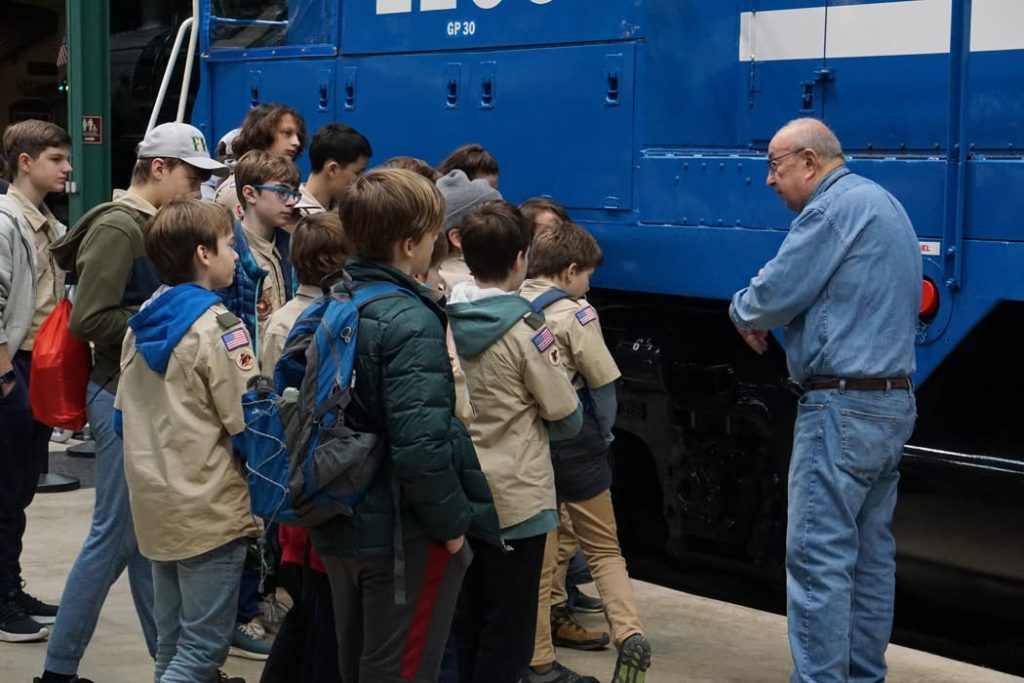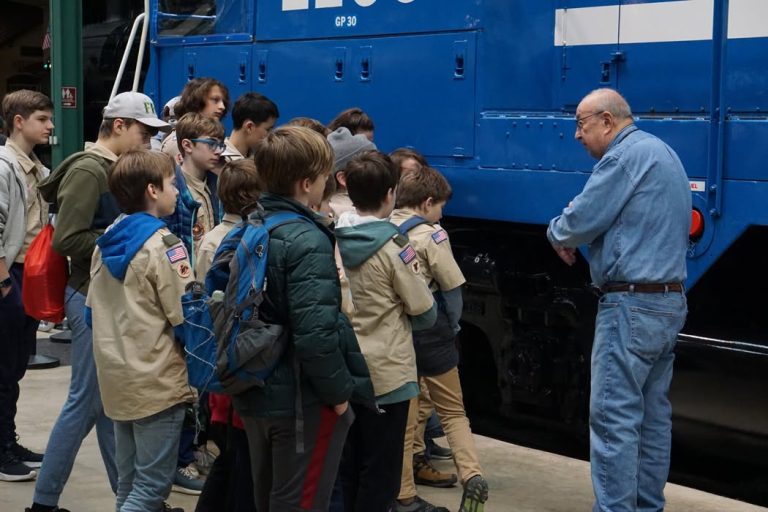
All aboard for immersive lessons in transportation history, engineering and innovation at the Railroad Museum of Pennsylvania, where enormous locomotives, historic railcars, artifacts and primary sources help students understand how railroads transformed work, travel and everyday life. Curriculum-based programs connect railroading to history, math, science, geography, economics and the arts. Younger students can explore a recreated 1915 train station, climb aboard a restored passenger car, and build a model section of track. Grades 4–5 investigate railroad jobs, tools and communication inside a wooden caboose and steam locomotive, while high school students compare steam, diesel-electric and electric power during the Parade of Power Tour.
What Students Will Experience
The museum’s guided school programs match different developmental levels and use the collection as the classroom.
For preschool through grade 3, Working on the Railroad “A” introduces students to the technology and jobs of early railroading. Groups move through a recreated 1915 station, board a restored 1931 passenger car and work together to construct a model section of railroad track. Guides use authentic and reproduction objects to help students consider how station workers, conductors and railroad crews performed their jobs before modern communication and transportation systems.
Working on the Railroad “B”, recommended for grades 4–5, moves students deeper into railroad operations. Learners examine telegraph technology in the station, practice flag signals used by brakemen and climb aboard a restored 1913 wooden caboose and 1905 steam locomotive. The experience emphasizes the practical ingenuity railroad employees needed to communicate, solve problems and keep trains moving safely.
For grades 9–12, the Parade of Power Tour turns locomotive technology into a walk through engineering history. Students examine steam, diesel-electric and electric locomotives, comparing how each system generated and transferred power and considering what technological changes meant for railroad workers and passengers. The tour also allows students to board selected locomotives and railcars from the collection.
The museum’s enormous collection adds another layer even outside formal programs. Students can compare locomotive size, materials, controls and design across eras, while historic passenger and freight cars reveal how railroads served different industries and communities.
Curriculum & Grade-Level Connections
The Railroad Museum specifically designs its education programming around academic standards in history, math, science, language arts, geography, economics and the arts.
That makes the museum particularly useful for interdisciplinary field trips. Elementary students can focus on transportation, communities, then-and-now comparisons and simple technologies. Upper elementary students can examine communication systems, specialized railroad jobs and the practical use of tools.
For older students, locomotive technology provides natural connections to physics and engineering. Steam power offers an entry point into heat and mechanical energy; diesel-electric locomotives connect combustion engines with electrical generation; and electric locomotives provide a clear example of changing energy systems.
History and economics teachers can use railroads to examine industrialization, westward growth, labor, commerce and the development of towns and cities. The museum’s collection also helps students understand how transportation networks made large-scale movement of raw materials, manufactured goods and people possible.
Schools that cannot travel to Strasburg can also use the museum’s traveling and virtual programs. Working on the Railroad brings tools, lanterns, uniform items, dining-car china and ticket punches into the classroom, while Live Steam Demonstration uses a working miniature engine to explain steam physics. K’NEX Rail Lab asks small groups to build and investigate railroad bridges, adding a hands-on engineering option.
Planning Your Visit
Guided curriculum programs currently cost $7 per student. For every five paid students, one chaperone is admitted free; additional adults pay the group rate. At least 10 students are required to book a program. Paid aides, one-on-one assistants and nurses accompanying students are admitted free.
Program length varies by age and topic. Working on the Railroad programs run roughly 45–60 minutes, while Parade of Power lasts about 60 minutes. Teachers should allow additional time for independent exploration, restroom breaks and the museum store.
The museum requires at least one adult for every 10 students at all times. Groups more than 30 minutes late may lose their reserved program and be shifted to a self-guided visit, so transportation schedules should include extra travel time.
Current public hours are Wednesday through Saturday from 10 a.m. to 4 p.m. and Sunday from noon to 4 p.m.; the museum is closed Monday and Tuesday. School programs cannot be reserved on days the museum is closed.
Teachers planning to ride the nearby Strasburg Rail Road or visit another Lancaster County attraction should tell museum staff when booking so the education team can help keep the program on schedule.