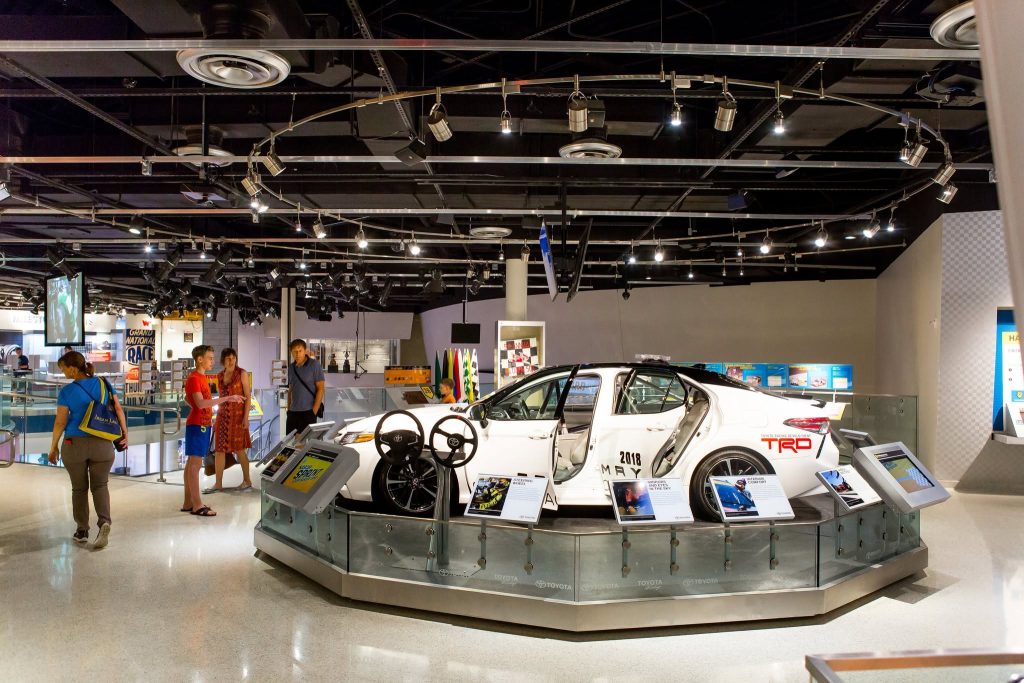

For students who love cars, competition, or anything that goes fast, the NASCAR Hall of Fame in Charlotte is an easy way to make learning more exciting. But even students who have never watched a NASCAR race can find plenty to enjoy. The Hall brings together the history, people, technology, and behind-the-scenes work that make racing possible, all under one roof. Through exhibits and interactive experiences, students can learn about legendary drivers and teams while getting a closer look at how the sport has changed over the years. It also reminds us that NASCAR is about much more than the person behind the wheel. Engineers, pit crews, mechanics, designers, broadcasters, and countless other professionals all play a role in getting a race car to the finish line.
Educational Opportunities
A field trip here gives students plenty of chances to do more than walk from exhibit to exhibit. Interactive experiences bring the fast-paced world of racing to life, allowing students to explore the sport in a hands-on, energetic way. Depending on the field-trip experience and current programming, students can learn about NASCAR’s history, the people who helped shape it, and the science and technology behind racing. The Hall’s exhibits immerse visitors in the excitement, passion, and history of the sport, while educational experiences encourage students to think about what happens before a car ever reaches the track. It is the kind of place where a student interested in engineering may be drawn to how a race car is built, while another who loves history may be more interested in the stories behind NASCAR’s biggest names and moments.
STEM Connections
For educators, the NASCAR Hall of Fame offers a fun way to connect a field trip to subjects students are already studying. Racing naturally opens the door to STEM concepts like physics, engineering, problem-solving, and technology. Students can explore how speed, force, aerodynamics, and teamwork all affect what happens on the track. The Hall also highlights the importance of collaboration, showing how drivers depend on crew members, engineers, and spotters to make quick decisions. Beyond science and math, the museum can connect to history, communication, and career exploration. Students may be surprised to discover just how many jobs exist in the motorsports industry, from mechanics and engineers to photographers, journalists, broadcasters, and marketing professionals. The Hall’s educational experiences show students how innovation and teamwork contribute to success both on and off the track.
Student Activities
Teachers can easily extend the experience beyond the field trip itself. Before visiting, students could choose a NASCAR-related career and research what skills, education, and training that job requires. During the trip, they could look for examples of technology or teamwork throughout the exhibits and record their discoveries in a simple field journal. Another fun classroom activity would be to challenge students to design their own race team, deciding who would take on jobs such as driver, engineer, mechanic, crew chief, or media manager. They could even create a car design and explain how their team would work together to solve problems. Activities like these can help students see that even a sport built around fast cars depends on creativity, communication, and a whole lot of teamwork.
The NASCAR Hall of Fame is the kind of field trip that can surprise students. They may arrive expecting to see race cars and famous drivers, but they can leave with a better understanding of the history, science, and people behind the sport. Its mix of interactive exhibits and real-world career connections makes learning feel less like a lesson and more like an experience. Whether students are longtime NASCAR fans or have no idea what happens during a pit stop, exploring a world built around speed, innovation, and teamwork is especially fun. For a North Carolina field trip that puts a little extra energy into STEM, history, and career exploration, the NASCAR Hall of Fame is definitely worth a spot on the starting line.